You adopted AI but the delivery timeline didn’t change. Our paper explains why →

US HEALTH TECH

AI MODERNIZATION

AI inside software you can't change. No rewrite.

It rides in through the browser, inside the session people are already signed into. No new app to learn, and the software’s maker builds nothing.

INDUSTRY

Line-of-business software / US health tech

SERVICE

AI Modernization

ENGAGEMENT

2+ years, ongoing

TEAM

Entire tech org, ~21 people

ON THIS PAGE

    OUTCOMES

    What this could reach once it ships

    180K+

    Physicians and nurse practitioners would again personalized, automated workflows beyond a standard EHR

    110K+

    Facilities cold run this with zero new integration work, using the EHR's own APIs directly.

    Thousands

    Of endpoints unlocked, typically everything an EHR has to offer, instead of just the 200 to 300 exposed via FHIR

    From the client

    “It’s great that we have built this browser extension. I am very excited that we can now use it with any web application to expand agentic automations for their use cases”

    [Pending client sign-off],
    Founder, Rolai


    Users live inside legacy software AI can't reach.

    It was challenging for clinicians to reach parts of the EHR that FHIR doesn’t cover: the full provider directory, messaging a provider, an insurance eligibility file, and writing back to a progress note. FHIR, healthcare’s standard for sharing clinical data, exposes only a thin, fixed slice of what’s inside an EHR: enough for basic use cases, but well short of the full picture.

    Everything FHIR leaves out sits behind the EHR vendor’s own internal interfaces, which have no standardized integration path. That leaves two options: don’t reach that data, or wait, often indefinitely, for the vendor to build a custom API for each data need.

    The enterprise AI platform’s founder summed up the problem clearly:

    “The endpoints that are there today are not adequate to build the richness of the applications that users are asking for.”


    A browser extension: if it's on the screen, we act on it.

    Incubyte worked as the platform’s cross-functional team across product management, infrastructure, DevOps, development, QA, and design, and solved this in two phases:

    01

    Standard data, the standard way.

    We built a FHIR connector for the platform: a FHIR MCP server paired with a matching MCP client. This lets the platform plug into any FHIR-compliant healthcare system and pull standardized patient and clinical data immediately and safely.

    02

    The data FHIR can't reach.

    For everything outside FHIR’s scope, we built a way to call an EHR’s internal APIs directly via a browser extension running within the clinician’s already authenticated session. This reaches data FHIR doesn’t expose, such as looking up every provider and their ID, messaging that provider, reading an eligibility file, and more.

    03

    User Continuity

    Operates no-API software on the user’s behalf. A payer portal, filled from EHR data. Roadmap.

    04

    Event-driven flows

    A change in a connected system fires a flow and notifies the right people. In production.

    Together, the two phases mean the clinicians can reach the complete clinical picture with zero dependency on the EHR vendor shipping a new API or engaging tech teams to integrate those APIs.

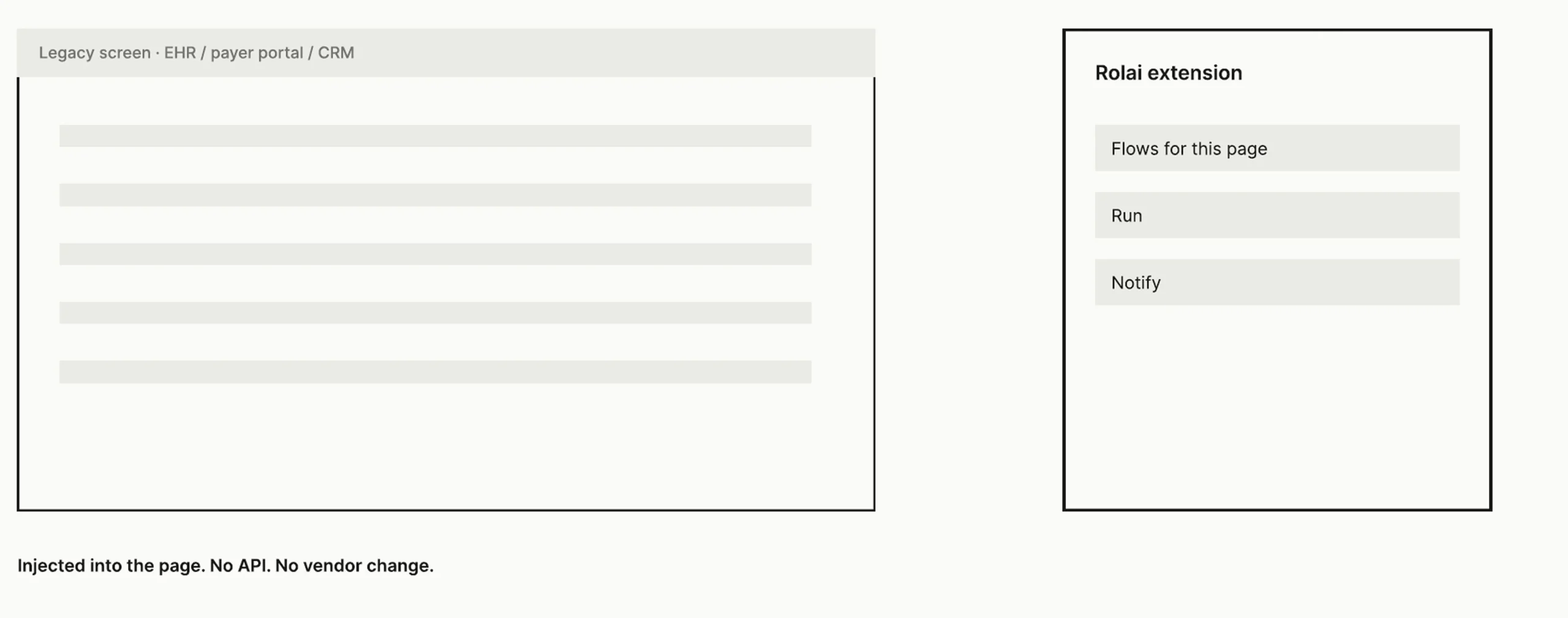
    INSIDE THE LEGACY SCREEN
    *[Pending client sign-off]

    Live with real users, and still shipping.

    We’ve built the capability and are targeting release alongside the EHR vendor’s next product update. It isn’t live with end users yet.

    This becomes important for the platform’s customers in healthcare because it builds AI capability directly into a clinician’s existing EHR and workflows, extending what practices can do with the systems and data they already run on.

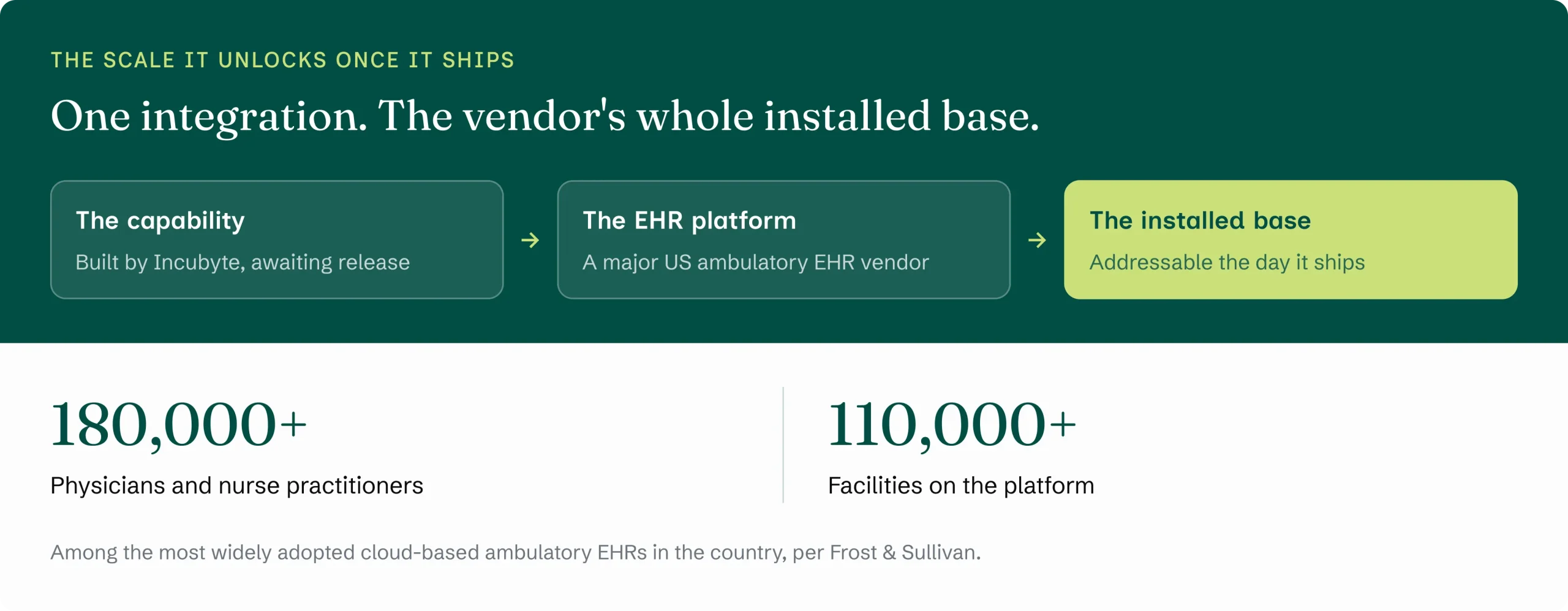
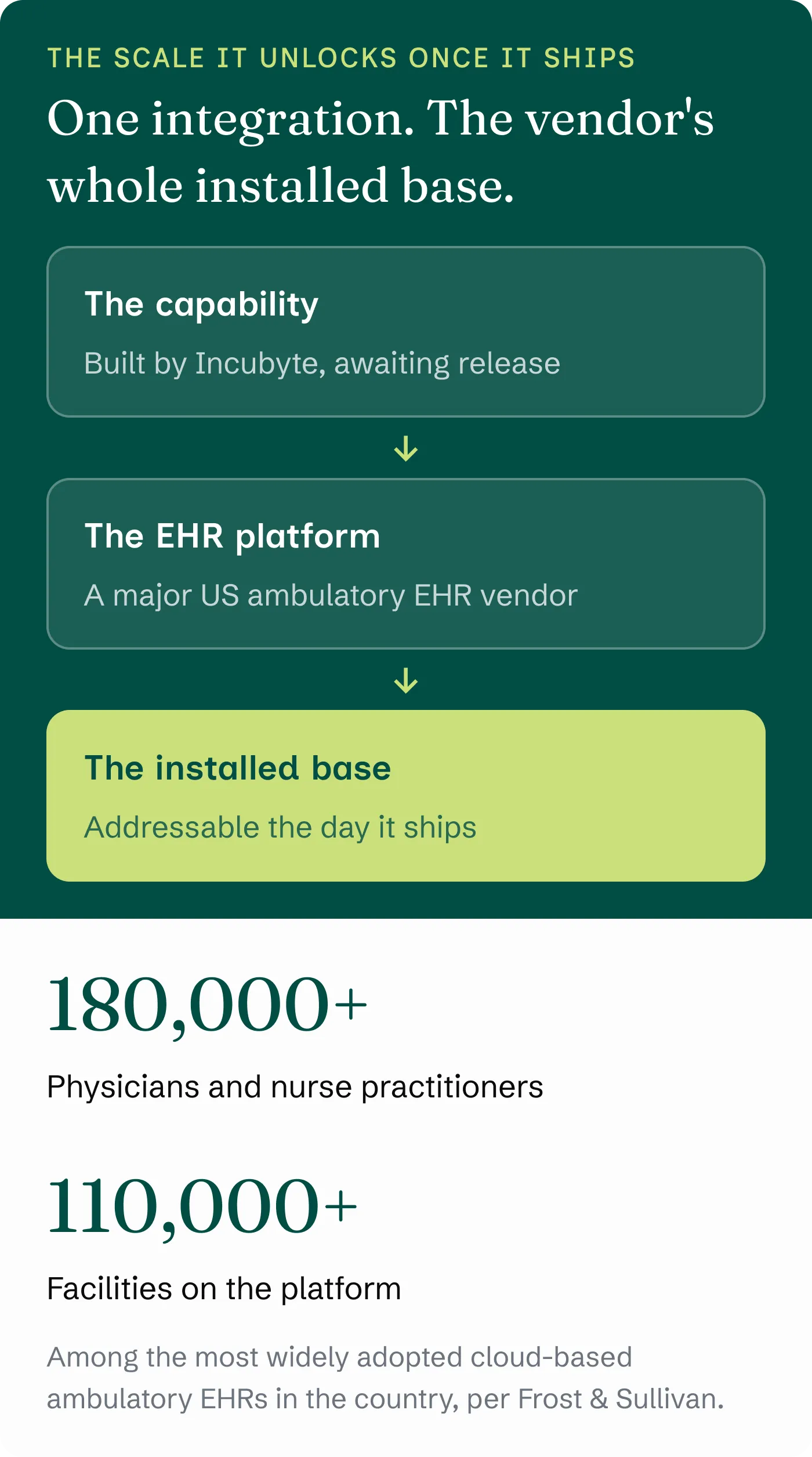
    The scale it unlocks once it ships: The enterprise AI platform’s partner for this work is a major US ambulatory EHR vendor, among the most widely adopted cloud-based ambulatory EHRs in the country (per Frost & Sullivan), with 180,000+ physicians and nurse practitioners and 110,000+ facilities on its platform. That installed base becomes the addressable population for the platform’s AI capability once it’s released.

    On watching the system pull lab results, have them interpreted by AI, and write them back into a progress note, the platform’s founder said:

    METRIC

    Throughput

    Event response

    Vendor asks

    BEFORE

    Manual, tab by tab

    Manual follow-up

    An API per workflow

    AFTER

    At scale, unattended

    ~18 seconds

    None

    “Brilliant! Brilliant. This is fantastic work, everybody. Thank you all.”

    And on the security model behind both phases:

    “It takes care of our concern regarding isolation… both sides is isolated very well… and yet it gives us the power to continue to move forward really fast.”


    1

    Day one,
    5 developers

    2

    Entire tech org,
    PM through design

    3

    ~21 people,
    first enterprise customers

    4

    Enterprise EHR partner,
    next release


    01

    Composition

    Product management, infrastructure, DevOps, development, QA, design. One team, end to end.

    02

    Ownership

    The team that builds it runs it. Nothing handed over, nobody rotates off.

    03

    Governance

    Runtime credentials, isolated surfaces, SOC 2 and HIPAA on the platform.

    04

    Growth

    Five developers at the start, about twenty-one today, as the product scaled.

    Tech

    Spec-Driven Development

    TDD

    CI/CD

    Browser Extension 

    FHIR MCP

    HIPAA

    Team

    Akshay Vadher

    Software Craftsperson – Tech Advisor

    Sanket Dhokte

    Technical Product Craftsperson

    Yogendra Jaiswal

    Software Craftsperson


    Rolai is an enterprise AI platform: an AI Workbench, Agents, and Automation on top of the software and data an organization already runs on. Incubyte is Rolai’s entire embedded engineering organization, two years and counting.

    The problem is the one most enterprise AI never gets past. The people who would benefit most, a clinician inside an EHR, a biller inside a payer portal, a rep inside a CRM, know their software cold and will not leave it for a separate AI app. Most of that software has no API, and no vendor is building one for every workflow.

    We built a browser extension that brings the AI to them instead. It runs inside the user’s already-authenticated session, reads the page, and surfaces the flows and applications relevant to that screen. Because it operates inside the session, it can act on software that exposes no API at all, with nothing requested from the software vendor. In the founder’s words: “Sometimes you want to write to that one field and there’s no API available, but you’re on that web page.”

    Event-driven automation closes the loop. When something changes in a connected system, a flow fires and the right people are notified automatically, about 18 seconds end to end. In one month, the customer’s own analytics dashboard recorded roughly 230,000 flow runs on the platform.

    The cadence continues because the team does. AI actions injected directly onto legacy screens are releasing soon. Portal operation, filling a patient’s prior authorization form from EHR data, is on the roadmap, projected to save about six hours of manual work per run. A customer-requested check-in flow would collapse about eight screens into one. Roadmap items are labeled as roadmap; the 230,000 runs are not.

    The pattern proved out in US health tech and generalizes to any web-based legacy software: payer portals, CRMs, other line-of-business apps. For teams weighing modernization against a rebuild, this is the third path: leave the legacy software where it is, and put the AI inside it.


    Frequently asked questions.

    How do you add AI to legacy software that has no API?

    Through the browser. Rolai’s extension runs inside the user’s already-authenticated session, reads the page, and acts on it, so it can reach and operate software that exposes no API, with nothing requested from the vendor. In the founder’s words: “Sometimes you want to write to that one field and there’s no API available, but you’re on that web page.”

    Through the browser. Rolai’s extension runs inside the user’s already-authenticated session, reads the page, and acts on it, so it can reach and operate software that exposes no API, with nothing requested from the vendor. In the founder’s words: “Sometimes you want to write to that one field and there’s no API available, but you’re on that web page.”

    Through the browser. Rolai’s extension runs inside the user’s already-authenticated session, reads the page, and acts on it, so it can reach and operate software that exposes no API, with nothing requested from the vendor. In the founder’s words: “Sometimes you want to write to that one field and there’s no API available, but you’re on that web page.”

    Through the browser. Rolai’s extension runs inside the user’s already-authenticated session, reads the page, and acts on it, so it can reach and operate software that exposes no API, with nothing requested from the vendor. In the founder’s words: “Sometimes you want to write to that one field and there’s no API available, but you’re on that web page.”

    Through the browser. Rolai’s extension runs inside the user’s already-authenticated session, reads the page, and acts on it, so it can reach and operate software that exposes no API, with nothing requested from the vendor. In the founder’s words: “Sometimes you want to write to that one field and there’s no API available, but you’re on that web page.”

    Through the browser. Rolai’s extension runs inside the user’s already-authenticated session, reads the page, and acts on it, so it can reach and operate software that exposes no API, with nothing requested from the vendor. In the founder’s words: “Sometimes you want to write to that one field and there’s no API available, but you’re on that web page.”

    Through the browser. Rolai’s extension runs inside the user’s already-authenticated session, reads the page, and acts on it, so it can reach and operate software that exposes no API, with nothing requested from the vendor. In the founder’s words: “Sometimes you want to write to that one field and there’s no API available, but you’re on that web page.”


    Weighing a rewrite?

    There’s a third path. Most of our work begins with a thirty-minute conversation.



    More work in us health tech

    FHIR ran out. The roadmap didn’t.

    Rolai, 0 new vendor APIs to reach the full record.

    Built by people who don’t code.

    Rolai, 1 weekend from prompt to a shipped interface.