
Read this paper if:
Nearly everyone on your team has an AI subscription
Cycle times have not reduced and overall productivity gains are elusive
You'd like a framework on how to move your team to AI fluency
Most AI spend is concentrated on coding, which is just a fraction of your delivery cycle (6% for the study in this report). Weeks go by in the other 94% of getting your ticket to production. Fluency is when the whole cycle moves faster, without losing trust in what’s delivered.
It is grounded in DORA’s research, experience from our team of AI Forward Deployed Engineers, and our 20+ years of experience building software for highly regulated industries.
Short on time?
CHAPTER 1
Adoption is not fluency
AI spends are concentrated on a small sliver of the delivery cycle associated with writing code. Productivity gains are realized when the entire cycle is compressed.
DORA and DX are two of the highly reputed research teams tracking AI adoption, and the implications of it on software delivery.
DORA’s 2025 survey of nearly 5,000 technology professionals found that 90% now use AI at work. Most tellingly, higher AI adoption was found to be associated with both, higher software delivery throughput and also higher delivery instability. This led DORA to conclude that AI is fundamentally an amplifier: it magnifies the strengths of high-performing organizations and the dysfunctions of struggling ones.
According to DX’s Feb 2026 report, AI usage rose 65%, but the quantum of work delivered rose just 7.76%. This is because coding is only ~14% of a developer’s day, and accelerating code generation simply relocates the constraint downstream to review, verification, and integration. Several developers stated that the time saved writing code is now being consumed by the extra scrutiny that AI output demands.
At one of our own healthtech clients, the entire delivery cycle was 11.7 weeks, of which, coding was just 6%. Tickets were spending almost 11 weeks either being stuck in queues, or in manual clarification, verification, reviews, or rework.
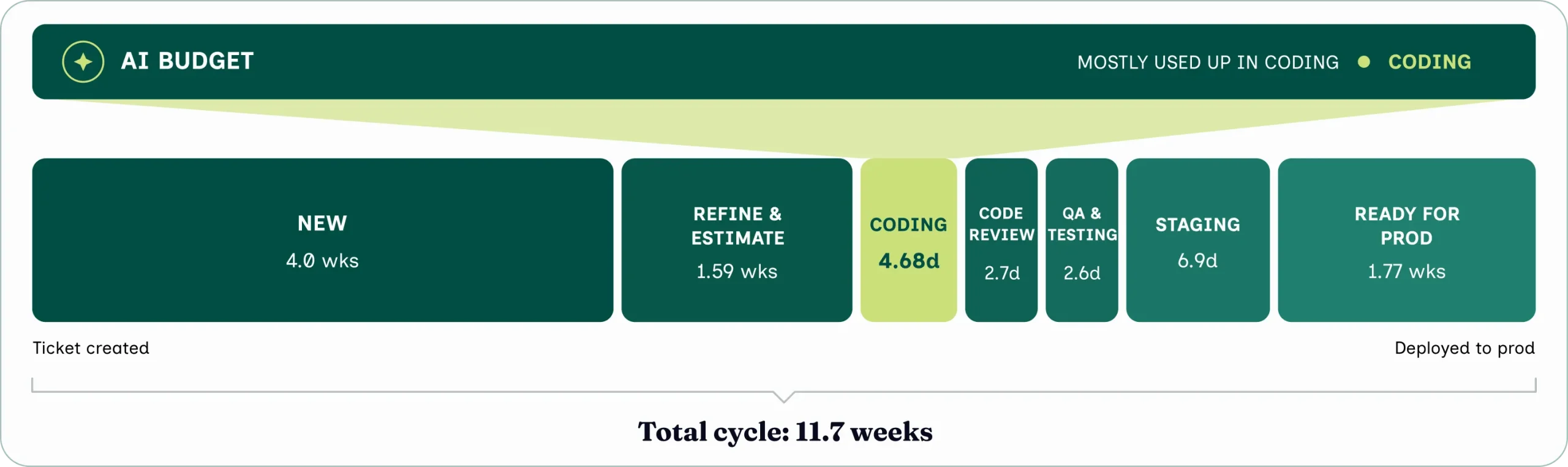
AI fluency, is when the entire cycle is compressed, without losing trust in what ships.
Adoption is easy to track: usage, licenses, AI-assisted commits. Fluency is measured by how much of the delivery cycle AI compresses, while stability, maintainability, technical debt and overall system quality improve rather than decline.
The next chapter introduces the core organizational framework required to propel this journey from adoption to fluency.
One caveat before we go further. Since AI amplifies the current state, the system has to be in a state that’s worth amplifying. Continuous delivery, automated tests, small batches, and loosely coupled architecture are table stakes that let teams compound their AI gains. When missing, teams are adding code at a speed that the system can’t absorb. Everything that follows assumes these foundations are in place.
of technology professionals now use AI day to day · DORA 2025
increase in throughput, despite 65% increase in usage (DX 2026)
of a developers time is spent on coding (DX 2026)
CHAPTER 2
The fluency stack
Fluency is built on the cultural foundation of an organization, as it applies to capabilities of its people and conduct of its agents.
DORA’s 2025 State of DevOps research published a core organizational model for engineering excellence: Capabilities drive software delivery performance, which drives organizational outcomes. Alongside it, they released an AI Capabilities Model with seven capabilities that amplify AI outcomes: A clear and communicated AI stance, healthy data ecosystems, AI-accessible internal data, strong version control practices, working in small batches, user-centric focus, quality internal platforms.
Our adaptation of the core model, abstracts these capabilities and introduces “Conduct” as an additional layer, which together drive engineering performance.
What your people can do with AI across the whole lifecycle, well beyond the coding stage. Judgment, breadth, business grounding, documented context.
What your systems hold your people and your agents to while they work. Standards, regulations, and data boundaries, enforced as the code is generated.
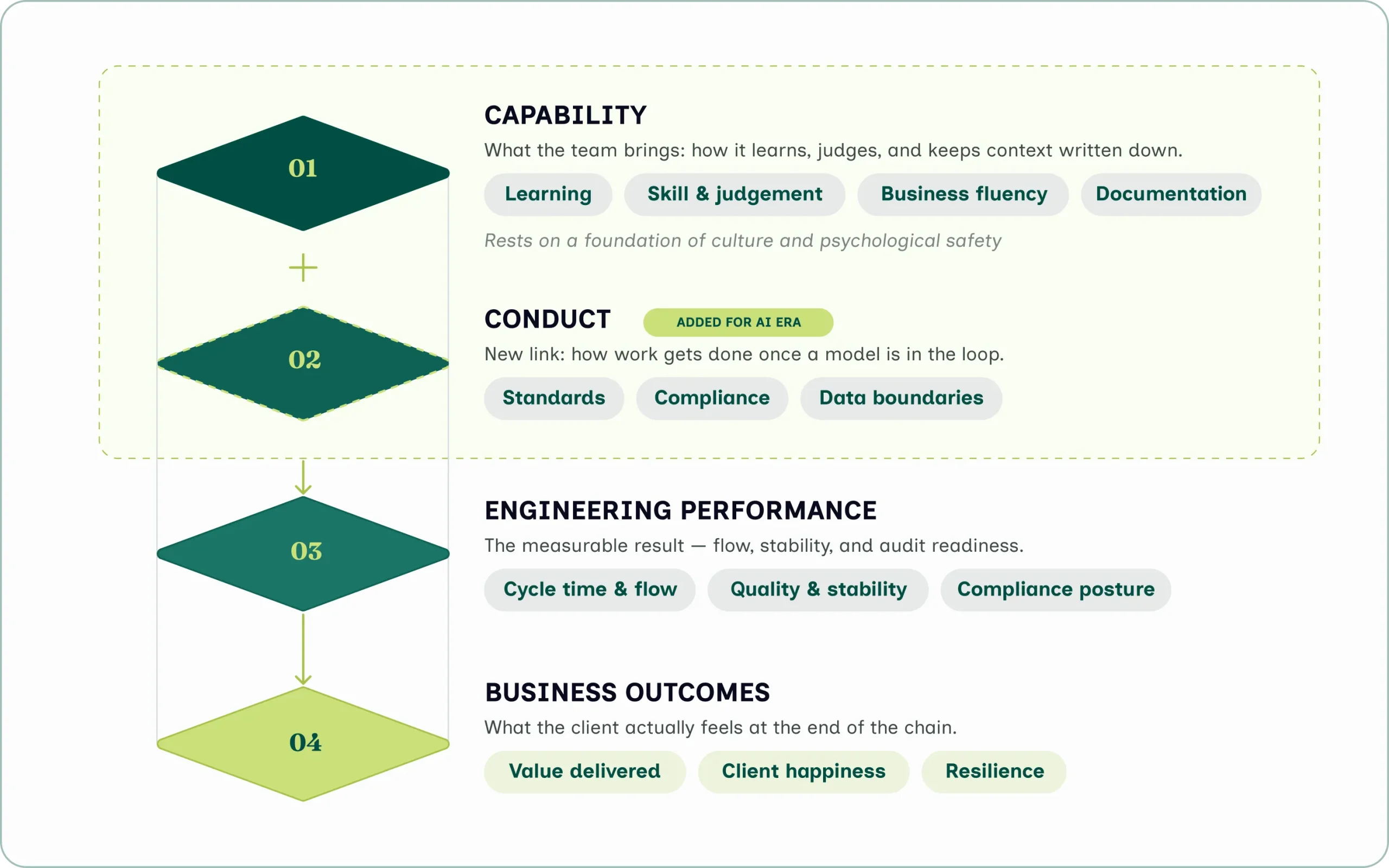
The next two chapters drill down into these layers to break down what it takes to build these into their organization’s playbook.
CHAPTER 3
The capability layer
Capability is what your people can actually do with AI across the whole lifecycle, and it is the first layer an organization is responsible for building.
Culture decides whether any capability takes root
Westrum’s research which DORA has validated over a decade shows that a culture where information flows freely, teams collaborate deeply, and failure is treated as a learning opportunity, the strongest predictor of whether any other capability converts into outcomes.
The strength of an AI-fluent PDLC lies in whether team members can hold each other accountable for what their AI produces. You cannot push sloppy code that raises the team’s review burden, and you cannot let your craft slide because your productivity is being closely monitored. Culture is about having the psychological safety to call this out.
Learning and continuous improvement
This is about how much your team collectively knows, whether you keep growing it, and how your people build the capability to catch AI’s mistakes before they ship. People who can name the patterns and architectures they work in can direct and check more of what the AI produces.
Leaders have to supply the conditions that enable learning:
Skill and judgement
Most clients begin noticing improvements within the first few weeks. For deeper operational changes, we typically see lasting impact within 2 to 3
One of DORA's seven AI capabilities is a Clear and communicated AI stance. The stance is enforced when the team has the skills and judgement to do so.
Business fluency
As AI absorbs the purely technical work, the edge that's left is the knowledge AI can't pull from the codebase or a prompt: how the business actually makes money, how this organization actually works, and the rules of the domain it operates in. With role boundaries blurring across product, engineering, and QA, each person own outcomes and that makes it critical for everyone to be fluent in what problems they are solving for their end users. This fluency is what lets a person direct AI toward the right decisions, and it is what keeps a system built around its domain rather than assembled in isolation.
Decisions grounded in how the business and the system actually work, not just the code, predict rework rate and value delivered. Teams with that grounding build the right thing the first time, making a huge impact on their overall cycle time.
Another of DORA's seven capabilities, user-centric focus is what business fluency enables, and ensures that AI-accelerated teams are moving quickly in the right direction.
cite "almost right, but not quite" as their top AI frustration · Stack Overflow 2025
would still ask a person when they don't trust an AI answer · Stack Overflow 2025
of enterprise GenAI pilots show no measurable return · MIT NANDA 2025
Knowledge and documentation systems
The first three dimensions are more about capabilities your people build. This one is about the systems that capture what the organization knows and makes relevant context available to both humans and agents. A model with no access to your architecture decisions, your domain glossary, your past incidents, or your coding standards will produce something generic. The same model, grounded in that context, produces something that fits with minimal reviews and rework.
Leaders build this by treating knowledge as infrastructure:
Modernization is now an AI prerequisite.
Code is the best form of documentation and coding agents can only go as deep as your codebase lets them. A legacy, undocumented, tightly coupled codebase keeps a team stuck at lower levels of fluency, no matter how good the capabilities are. Getting a codebase agent-ready, through documentation, decoupling, and test coverage, is a precondition for fluency, and a subject big enough for its own companion paper.
CHAPTER 4
The conduct layer
The enforcement half of fluency: standards, regulations, and data boundaries held while AI generates code, ensuring manual reviews are not the bottlenecks.
Conduct warrants a layer of its own in the AI era because human reviews can no longer keep pace with what AI generates. Building trust in what AI generates is the way forward.
The capability layer prepared your people and systems for AI. The conduct layer ensures your standards, regulations, guardrails, security rules, data boundaries, are all enforced while AI generates code. The cost of a leak missing human reviews could be catastrophic for a highly regulated domain, and conduct is what reduces the risk.
Coding Standards
Standards are your teams’ agreed upon way of coding. They’re a definition of what good looks like and how to reliably produce it. An agent will produce something that works, or passes tests. Standards are what steer the agent to produce code that your team can continue to own, read and change months later, preventing the slow quality erosion that teams are currently experiencing with higher AI use.
Organizations build this by turning standards into live context:
One of DORA’s AI capabilities is a clear and communicated AI stance. Chapter 3 argued the stance holds only when people have the skill to enforce it. Conduct is the other half that enforces the stance via rules that the agent follows.
Compliance posture
For compliance heavy domains like healthcare, or fintech, engineers are trained to ensure their code and conduct is compliant with HIPAA, PCI-DSS, SOC 2. The cost of a leak goes up the later it is found.
HHS OCR brought 16 HIPAA enforcement actions in 2024 (about $9.4M in penalties), and in late 2024 proposed the first major update to the HIPAA Security Rule in over 20 years (published January 2025). The proposed rule tightens encryption, risk-analysis, and resilience requirements for every system that handles ePHI. This brings AI-enabled teams squarely in scope of audits.
Data and security boundaries
An agent does not just read, it acts. It calls models, tools, and outside services, and each call can carry sensitive data out of your boundary or take an action you did not intend it to.
Intentionally govern what is allowed to cross the line:
Compliance and audit posture
AI moves PHI into places that matter for audits. In regulated software this outcome is non-negotiable, and AI changes the risk surface in ways most teams haven’t intended.
CHAPTER 5
Engineering performance
Higher engineering performance is evidence that your capability and conduct layers have been built right.
The four DORA metrics: deployment frequency, lead time, change failure rate, and time to restore, track the system’s health and measure a team’s ability to ship fast with safety. An AI-assisted PDLC raises the stakes as there’s a lot more code being generated, and this makes it even more critical to get early signals from these metrics as adoption grows. These are also the right signals on how the team is trending on its journey from adoption to fluency.
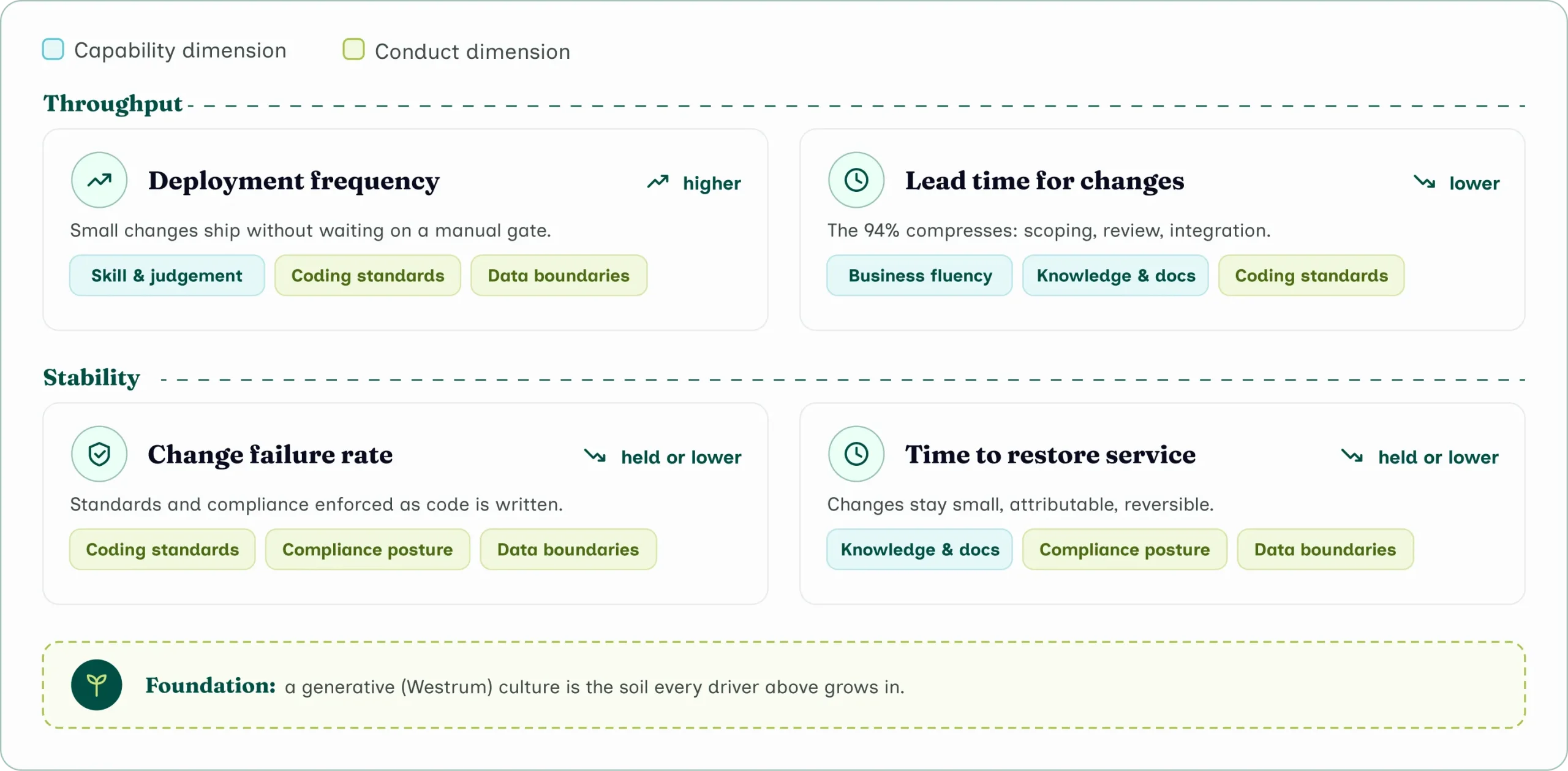
Throughput and cycle time
The whole cycle compresses, not just the coding sliver.
Stability
Change failure rate and time to restore hold as throughput climbs.
Code quality and technical debt
The codebase stays ownable months later with sustained developer and agent experience.
Compliance and audit-readiness
Compliance posture stays intact with evidence always available.
The next chapter defines our model for fluency and how these performance parameters translate to your team’s AI fluency.
CHAPTER 6
Reading your fluency
Fluency has two axes: how fast you move across the cycle, and how much of your trust AI has earned.
A team can feel fluent and yet, not be.
They may be shipping fast, with healthy dashboards, and high tool usage. Then a change that sailed through review takes down production, and it turns out nobody really knew what the AI had written. That gap, between feeling fluent and being fluent, is what this section helps you see.
Fluency is fast plus trusted.
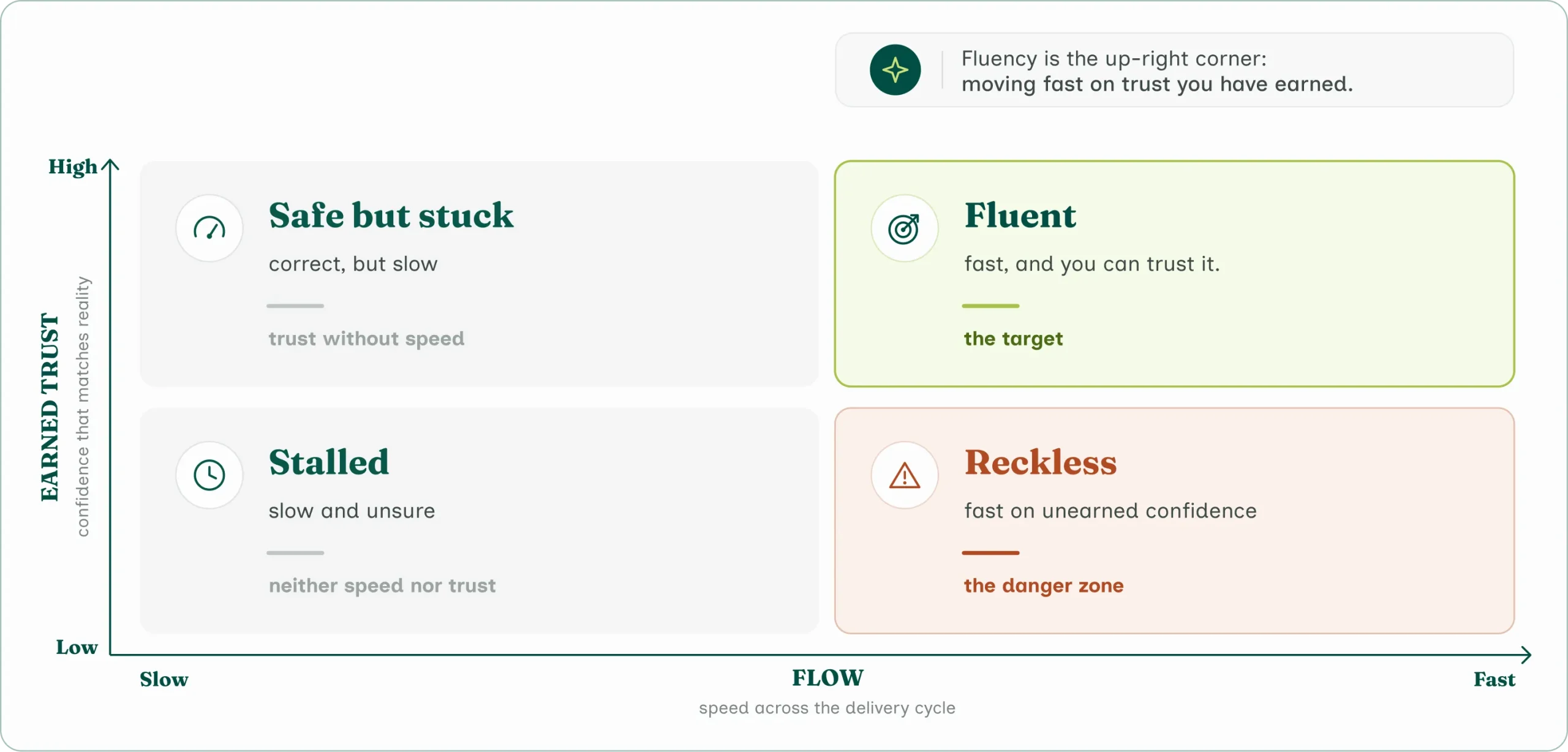
Fast and trusted at once. Its rare and is the target that this paper is advocating for.
Correct and sure of it, but slow. Careful teams live here and mistake it for fluency. The work is to speed up without giving up the feeling of safety.
Fast on confidence that hasn’t been verified. It looks like success, while quality degrades quietly. The risk of blowing up anytime makes it the most dangerous corner.
Slow and unsure. The pace of work is aligned with low confidence. The work here is to build capability and conduct that improve both, flow and trust.
The rest of this chapter helps you discern where your team stands on flow and earned trust.
Flow: the whole cycle moving without friction
Mihaly Csikszentmihalyi described flow as the state where you’re so absorbed in the work that it carries itself.
Work is in flow when a unit of work moves through the whole delivery cycle without stalling: no waiting in a queue, no bouncing back for clarification, no sitting in a review backlog for three days. When work flows, cycle time is low. When it keeps stopping, cycle time balloons, and you get our healthtech client from Chapter 1: 11 of their 11.7 weeks spent stalled, with actual coding taking just 6% of the cycle.
The biggest impact on lower cycle time comes when AI is able to carry a single unit of work on its own, without stalling. These are the five levels we use in our assessment:
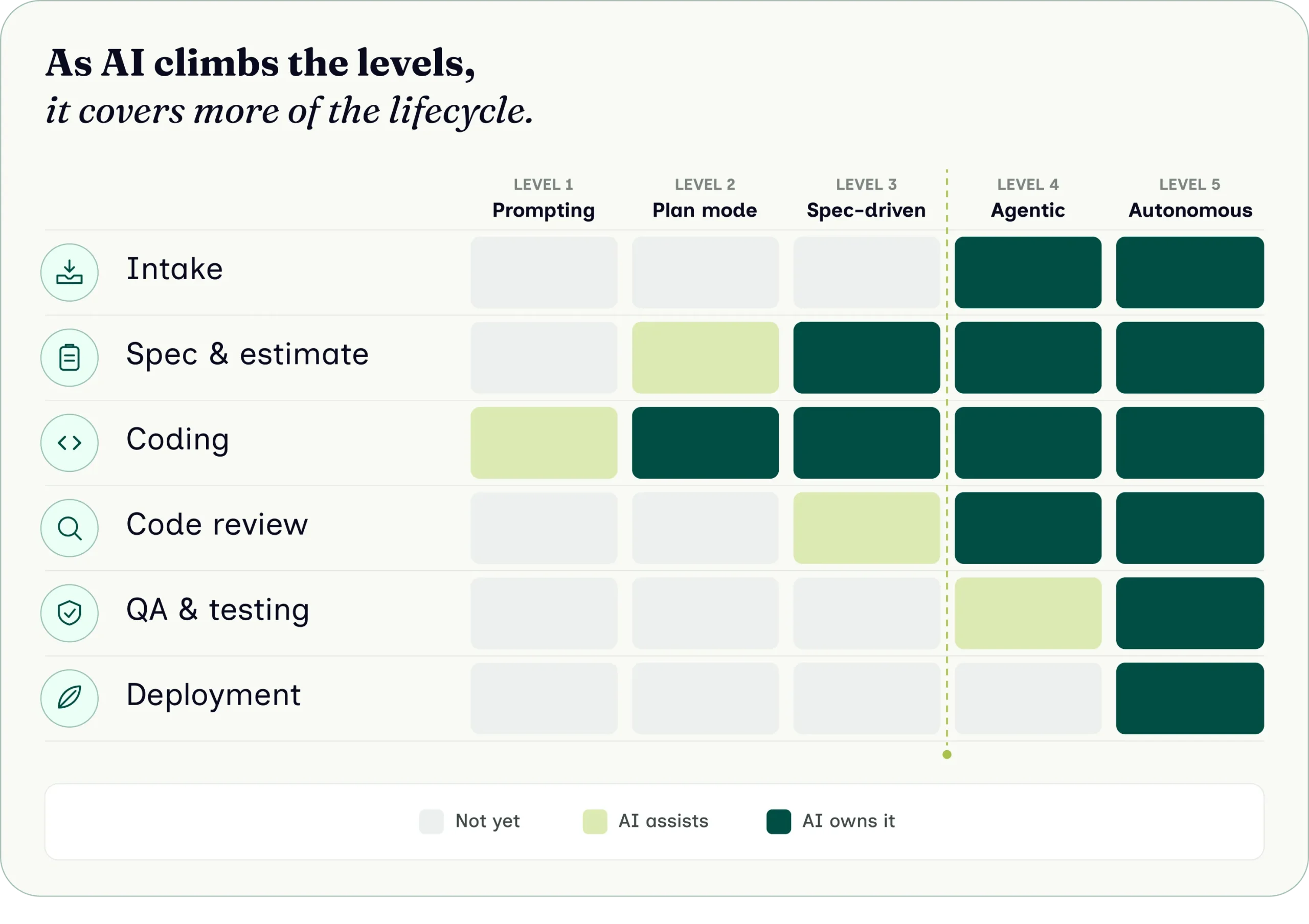
The jump from level 3 to level 4 is the one that has the highest impact on compressing the delivery cycle.
Earned Trust: Confidence that matches reality
Confidence on its own tells you nothing, because a team can feel completely sure and be completely wrong. What matters is whether that confidence is calibrated: whether what the team believes about its AI’s output matches what the code actually does.
Speed you never use.
The bill arrives later.
Earned trust is confidence you can defend, because your verification catches bad outputs, your track record of outputs meeting your AI stance, the amount of rework dropped, and stability of the system didn’t slip as you sped up.
The 3-point summary
Software teams have adopted AI fast, but benefits are still anecdotal. This paper examines why, and what separates the teams that convert AI into delivery gains, from those that do not.
A large part of the AI budget is currently spent on coding, which is a fraction of the entire delivery cycle. This is why productivity gains are elusive and cycle times are largely unchanged. There are spikes of productivity across the org but these are not predictable and sustained.
Fluency rests on two organizational layers. Capability - the culture, learning, judgement, and documentation practices that let people direct and check AI across the lifecycle. Conduct, the standards, regulatory rules, and guardrails enforced while AI generates code.
Fluency is when the full delivery cycle is compressed without losing trust in what ships. It can be measured by how much a team trusts the AI-assisted work, along with how much they've been able to reduce their cycle time and enable flow. It can be achieved when organizations build their capability and conduct around AI.
Answer six questions to understand where your team stands on their journey from adoption to fluency
Experience Audit
Methodology and sources
This brief combines public research with field observations from regulated-software engineering teams. The framework follows DORA’s capabilities → performance → outcomes model, extended with a conduct layer for the AI era. Field observations are illustrative of patterns we see in engagements and are labeled as such, not presented as a controlled study.